Best leather awl for stitching
An awl looks like the simplest tool on the bench, yet the wrong one ruins more seams than dull knives ever will. Here is which type to buy, which blade width, and when you can skip an awl entirely.
Quick answer
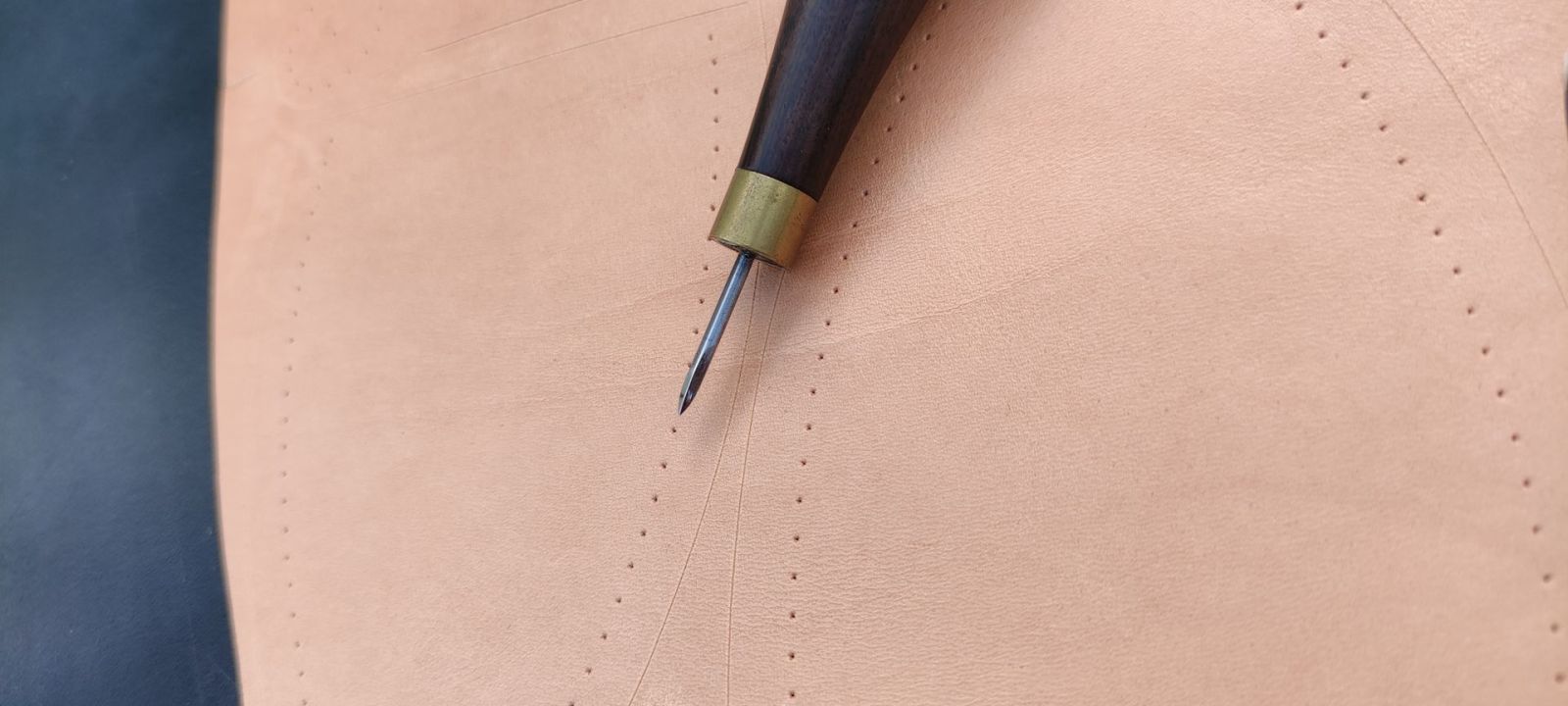
Buy a diamond stitching awl with a 1–1.2 mm blade — it opens the angled holes a saddle stitch needs on wallet-weight leather. A cheap scratch awl is worth adding for marking patterns and hardware points. If you punch with stitching chisels, you can postpone the awl — but on leather about 3 mm and thicker you will still want one to open holes that did not punch fully through.
“Awl” covers several different tools that happen to share a handle and a point. The one that matters for sewing is the diamond (stitching) awl: its blade has a four-sided, lozenge-shaped cross-section that cuts a clean angled slot, so stitches lie flat and slant the classic way. A scratch awl is a round spike for marking, a round awl opens existing holes without cutting fibres, and a curved awl reaches into moulded work and repairs.
Beginners who start with punch-through chisels (our pricking irons guide explains why most should) can treat the awl as a second-project purchase. Traditionalists who mark with true pricking irons open every single hole with the awl — that is the finer, slower path.
The four awl types, and the one to buy first
- Diamond stitching awl — the sewing awl. Four polished faces, lozenge cross-section, cuts an angled slit that matches the marks left by pricking irons. Buy this first.
- Scratch awl — a round, tapered spike for tracing patterns, scribing lines and starting rivet or snap holes. Cheap and endlessly useful; never use it for stitch holes, because a round hole fights the slanted stitch.
- Round awl — smooth needle-like point that gently enlarges an existing hole without cutting new fibres. Handy, not essential.
- Curved awl — a bent blade for moulded goods and awkward angles, mostly a saddler’s tool. A later addition, if ever.
Blade width: match the awl to the leather
Diamond blades are sold by width, and the match is to leather thickness and thread size, not to hand size:
| Blade width | Leather | Thread | Typical work |
|---|---|---|---|
| 0.8–1 mm (fine) | 0.8–2 mm (2–5 oz) | 0.45–0.6 mm | Card holders, slim wallets |
| 1–1.2 mm (medium) | 2–3 mm (5–7 oz) | 0.6 mm | Wallets, notebook covers |
| 1.2–1.5 mm | 3–5 mm (7–12 oz) | 0.8–1.0 mm | Belts, straps, small bags |
| 1.5 mm + (wide) | 5 mm + (12 oz +) | 1.0–1.2 mm | Holsters, saddlery, briefcases |
Fixed awl or haft with interchangeable blades?
A haft is a universal handle that accepts different blades — one comfortable grip, several widths, less money than separate awls. It is the practical choice once you sew more than one weight of leather. Two things to check: the collet must actually hold the blade rigid (wobble ruins accuracy), and when you seat a blade, leave no less than about 7/8 in (22 mm) of blade showing so it can pass a thick seam.
A fixed awl is simpler and always ready. If you only sew wallet-weight leather at 3.38–3.85 mm pitch (check yours with the stitch pitch converter), one fixed 1 mm awl covers you for years.
Sharpness is everything (and cheap awls are not sharp)
A stitching awl should slide through cased leather with wrist pressure, not get muscled through. That takes a mirror polish on all four faces. Budget awls arrive rough-ground; ten minutes on a strop loaded with green compound (see our sharpening guide) turns most of them into good tools. Strop again before every long session — a blunt awl tears fibres, makes ragged holes, and is far more likely to slip into your other hand.
Awls worth putting on the bench
Start with a diamond awl (or haft set) and a scratch awl; add curved blades only when the work demands them.
-
Diamond Stitching Awl (fixed, ~1 mm blade)
- Size
- ~1 mm diamond blade
- Weight
- 2-6 oz
- Blade
- hardened steel
- Level
- Intermediate
The classic partner to pricking irons: opens each marked hole as you sew. Polish all four faces to a mirror — a rough awl tears fibres.
Reviewed 2026-07-20 -
Awl Haft + Interchangeable Blades
- Size
- universal haft | 3 blades
- Weight
- 3-10 oz
- Blade
- hardened steel
- Level
- Intermediate
One comfortable handle that takes fine to wide diamond blades. Leave at least 7/8 in of blade showing when you set it.
Reviewed 2026-07-20 -
Scratch Awl (round point)
- Size
- round tapered point
- Blade
- steel
- Level
- Beginner
For tracing patterns and marking hardware positions — not for stitch holes. Every bench needs one.
Reviewed 2026-07-20 -
Curved Saddler's Awl
- Size
- curved diamond blade
- Weight
- 4-12 oz
- Blade
- hardened steel
- Level
- Advanced
Reaches where a straight blade cannot — moulded work and repairs. A later addition, not a first buy.
Reviewed 2026-07-20
Key takeaways
- Buy a diamond stitching awl (1–1.2 mm) first; add a cheap scratch awl for marking.
- Chisel users can wait — but leather over ~3 mm usually needs an awl to finish the holes.
- A haft with blades beats separate awls once you sew several leather weights.
- Polish all four faces to a mirror and strop before every session.
This guide sits in a loop of hands-on leathercraft lessons — move forward to how to saddle stitch leather (step by step) or revisit diamond chisel vs French-style irons first.
Frequently asked questions
Do I need an awl if I use stitching chisels?
Not at first. Chisels punch finished holes, which is exactly why we recommend them to beginners. You will want a diamond awl once you sew stacks around 3 mm and up, where chisel holes often do not make it cleanly through both layers.
What is the difference between a stitching awl and a scratch awl?
A stitching awl has a diamond-shaped blade that cuts an angled slit for sewing. A scratch awl is a round spike for marking lines and points. They are not interchangeable — round holes make a saddle stitch sit flat and lifeless.
What size awl blade for wallets?
A 1–1.2 mm diamond blade suits wallet leather (2–3 mm total) sewn with 0.6 mm thread at 3.38–3.85 mm pitch. Finer blades suit card holders; wider blades suit belts and bags.
Why does my awl need sharpening if it is new?
Most awls ship rough-ground. The blade needs all four faces polished to a mirror so it slides between fibres instead of tearing them. A leather strop with green chromium-oxide compound does it in minutes.
What is a sewing awl with a thread spool in the handle?
That is a lockstitch repair awl. It is for fixing tarps, canvas and the odd emergency repair — not for fine leatherwork, where the two-needle saddle stitch is stronger and neater.