Rivets vs stitching: when to use each
One is a two-minute mechanical join; the other is the strongest seam in leatherwork. Choosing between them is really about what the joint has to survive.
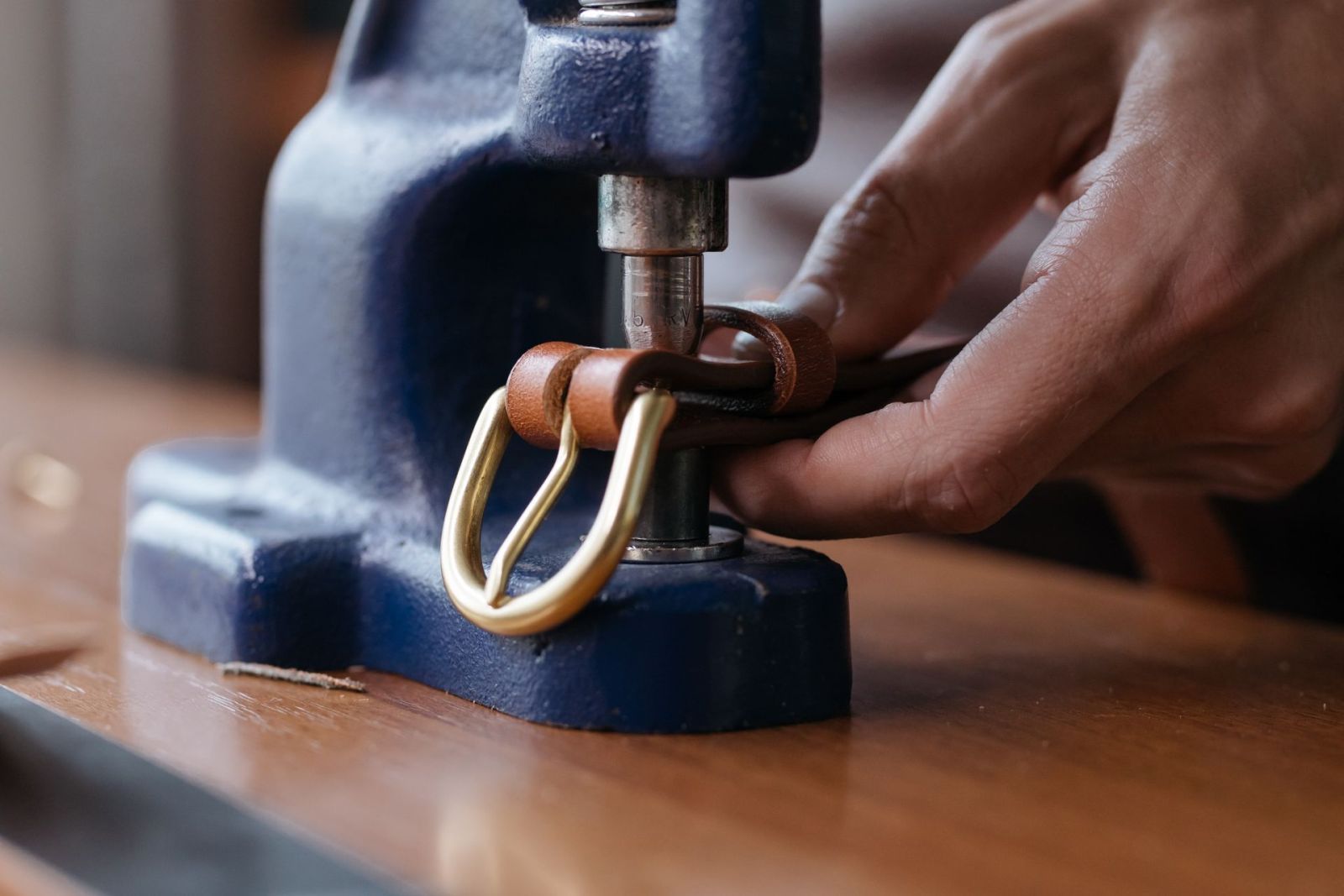
Quick answer
Use a saddle stitch for seams — long joins, edges, anything structural along a line. Use rivets for point loads and pivots: buckle folds, strap ends, D-ring anchors, and anywhere layers try to peel apart at one spot. The strongest work combines them — stitch the seam, then set a rivet at the stress point where the pull concentrates.
A saddle stitch distributes load along dozens of independent lock points — cut one stitch and the seam still holds. A rivet concentrates its strength in one steel or brass column that will never loosen, stretch or abrade. Neither is “stronger” in the abstract; they resist different forces. Thread resists shear along a seam; a rivet resists peel and pivot at a point.
Once you see joints that way, every hardware decision on a strap, bag or belt makes itself.
How each join carries load
Stitching shines when force spreads along a line: gusset seams, wallet edges, bag bodies. Dozens of stitches each take a fraction of the load, and the two-thread saddle stitch means a single worn stitch does not run. Its weakness is the point load — one spot levered back and forth (a buckle fold) works the thread until it saws through.
Rivets shine exactly there: a metal post with caps clamps the layers so the pivot works against solid brass instead of thread. Their weakness is the line: a row of rivets along a seam turns the leather between them into a perforated tear line under tension — like postage stamps.
A rivet through a 6 mm stack
Post length should exceed the stack by about 3 mm (1/8 in) — enough to clinch, not enough to bend.
Side by side
| Factor | Saddle stitching | Rivets |
|---|---|---|
| Best at | Seams, edges, structure | Point loads, pivots, folds |
| Failure mode | Gradual abrasion, repairable | Sudden tear-out if leather fails |
| Speed | Slow (minutes per inch) | Seconds per rivet |
| Tools needed | Irons, needles, thread, pony | Punch, setter, mallet |
| Repair | Restitch anywhere | Drill out and replace |
| Look | Handmade, refined | Utilitarian, workwear |
| Adjustability | Permanent | Chicago screws are removable |
Where each belongs (and where both do)
- Belt buckle folds: classic both-territory. Stitching looks dressier; rivets or Chicago screws survive daily pivot better and let you swap buckles. Many makers stitch the fold and add one rivet at the throat.
- Bag straps and D-rings: rivet the anchor point, stitch the strap body. The rivet takes the peel force; the stitch takes the run of the load.
- Wallets and small goods: stitch everything — rivets add bulk and there are no point loads worth reinforcing.
- Dog collars and leashes: stitch and rivet the hardware ends. A leash snap works its joint thousands of times; redundancy is the point (sizing help: rivet & Chicago screw calculator).
- Repairs and removable parts: Chicago screws — the “rivet” you can service with a flathead.
The verdict
Stitch the lines, rivet the points. If a joint flexes around a pivot or peels at one spot, set a rivet (our rivet-setting guide takes ten minutes to learn). If it carries load along a length, stitch it. When a strap’s life depends on one anchor, do both — the rivet backs up the stitch and vice versa. What you should not do is use rivets to avoid learning to stitch: a riveted-only seam on a bag is a tear line waiting for a heavy load.
Rivets, screws & setters
Double-cap rivets for looks, rapid rivets for hidden joins, Chicago screws for anything you may undo.
-
Double-Cap Rivets Assortment
- Size
- 6/8/9/10/12 mm posts
- Level
- Beginner
Two capped faces for a finished look both sides. Post length must match your leather stack — see the rivet calculator.
-
Rapid / Single-Cap Rivets
- Size
- assorted
- Level
- Beginner
One capped face, one flat — quick and cheap for hidden joins. Set on a hard surface with the matching tool.
-
Rivet Setter + Anvil
- Size
- setter + concave anvil
- Level
- Beginner
The concave anvil and domed setter shape the cap without flattening it. Match the setter size to the rivet cap.
-
Chicago Screws Assortment
- Size
- 4-12 mm barrels
- Level
- Beginner
Screw-together posts for removable, no-tools joins — ideal for straps you may adjust. Barrel length ≈ your leather stack.
Key takeaways
- Stitching spreads load along a line; rivets clamp a single point.
- Buckle folds, D-rings and pivots want rivets; seams want thread.
- The strongest joints use both — stitch the seam, rivet the stress point.
- Chicago screws are the serviceable alternative for removable joins.
Keep building your bench skills: the next stop in this series is rivet & Chicago screw length calculator, and the step before it was best leather rivets & setters.
Frequently asked questions
Are rivets stronger than stitching?
At a single point, yes — a brass post outlasts thread at a pivot. Along a seam, no — a row of rivets perforates the leather and invites tearing, while a saddle stitch spreads the load across dozens of lock points.
Can I rivet instead of sewing a belt?
You can rivet the buckle fold — plenty of sturdy belts do. But do not build the belt’s length joints from rivets; anywhere leather overlaps under tension along a line should be stitched.
What is a Chicago screw?
A two-part post-and-screw fastener that works like a removable rivet. Ideal for buckle folds you may want to swap and for repairs. Add a drop of removable thread-locker so it cannot back out.
Do rivets weaken leather?
Each rivet hole removes material, so a tight row of them creates a perforated tear line. One or two rivets at a genuine stress point, properly sized, strengthen the assembly rather than weaken it.
Should I stitch and rivet the same joint?
On hard-use anchors — leash hardware, bag handles, tool straps — yes. The stitch carries the everyday load; the rivet stops peel and survives the day a stitch finally wears through.